Skip to content

CardioCharge Ingredients: What Each of the Seven Does

Seven ingredients, each with a printed amount and a clear job. Here is a plain-language tour with links to outside references.

Order CardioCharge

Secured payment · 365-day money-back guarantee

CardioCharge Supplement Facts Summary

Active ingredients and amounts per serving. Select a name to jump to its section.

CardioCharge supplement facts summary · amount per serving
IngredientAmountGeneral role
D-Ribose3,000 mgCellular energy (ATP) production
Hibiscus flower extract (4:1)470 mgPlant polyphenols and anthocyanins
Hytolive® olive extract30 mgOlive-fruit polyphenols (hydroxytyrosol)
Potassium (as potassium citrate)380 mgElectrolyte for fluid balance and muscle contraction
Magnesium (as magnesium glycinate)190 mgMineral for muscles, nerves and energy metabolism
Sodium (as sodium citrate)140 mgElectrolyte that helps regulate fluid balance
L-Glycine1,000 mgAmino acid used to build proteins

Package: 20 servings per tub · net wt. 4.11 oz (116.4 g) · pomegranate flavor (artificially flavored) · prepare with water as directed on the label

Keep exploring: Home page Official overview

Every Active Ingredient in CardioCharge, Explained

Each entry covers what the ingredient is, its general role, why it is in the formula and how it fits the product’s purpose.

Soft white powder representing D-Ribose

Ingredient 1 of 7 · 3,000 mg

D-Ribose

What it is

D-Ribose is a simple sugar your body makes on its own and also finds in small amounts in food. It forms part of ATP, RNA and other molecules that every cell uses.

General role

Its role is to participate in the creation of ATP, the molecule that stores and transfers energy for countless biological activities. Nutrients connected to that pathway are common in energy-focused formulas.

Why it is in the formula

CardioCharge lists 3,000 mg per serving. Giving it the largest share of the formula tells you what the designers consider the core of the recipe: nutritional energy support minus any stimulant.

How it fits CardioCharge's purpose

Because the heart is a constantly working muscle, energy nutrition pairs naturally with a heart-and-electrolyte product. Still, studies on D-Ribose alone do not prove the same result from this finished drink, so it is best viewed as supportive nutrition.

How it powers the formula Back to the home-page overview D-Ribose studies on PubMed

Macro photo of a magenta hibiscus flower

Ingredient 2 of 7 · 470 mg

Hibiscus Flower Extract (4:1)

What it is

Hibiscus sabdariffa is a flowering shrub whose red calyces are brewed into tea and used in foods worldwide. The 4:1 designation means about four parts of dried flower produce one part of extract.

General role

The calyces contain polyphenols, notably anthocyanins, which give the plant its ruby color and its antioxidant character. Studies have explored hibiscus in connection with blood pressure measurements.

Why it is in the formula

The formula includes 470 mg per serving as its main botanical. Its flavor also suits a pomegranate drink, so it works as both a functional and a sensory piece of the recipe.

How it fits CardioCharge's purpose

It fits the product’s heart-wellness aim as a plant-based nutritional ingredient. Evidence is limited and was not gathered on CardioCharge, so it is not a treatment for hypertension, and people on blood pressure medication should consult their clinician.

See it beside the other ingredients Back to the home-page overview Hibiscus research on PubMed

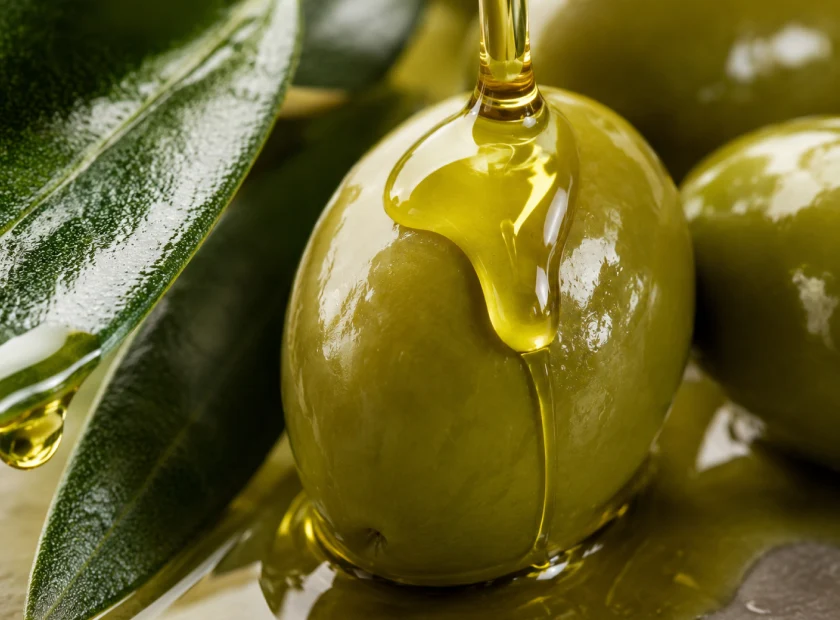
Glossy green olives with olive oil running down one fruit

Ingredient 3 of 7 · 30 mg

Hytolive® Olive Extract

What it is

Hytolive® is a branded olive-fruit extract. Olives are known for polyphenols, and hydroxytyrosol is among the most discussed of them.

General role

As antioxidants, olive polyphenols may help the body cope with everyday oxidative stress. They are a familiar topic in diet and wellness research.

Why it is in the formula

The label shows 30 mg per serving. Standardized extracts concentrate their active compounds, so a small milligram figure still represents a purposeful inclusion.

How it fits CardioCharge's purpose

In this formula, olive extract complements hibiscus. Two different plants contribute polyphenols to a recipe whose other components are minerals, an energy nutrient and an amino acid, supporting the antioxidant dimension of the product.

Compare all seven ingredients Back to the home-page overview Hydroxytyrosol research on PubMed

Fine crystalline salt grains representing potassium citrate

Ingredient 4 of 7 · 380 mg

Potassium (as Potassium Citrate)

What it is

Potassium is a mineral that becomes a charged particle in body fluids, which makes it an electrolyte. Most of it lives inside your cells.

General role

It contributes to normal fluid balance, nerve transmission and muscle contraction, and heart muscle depends on well-timed electrical signals. Adequate intake is part of a heart-conscious diet.

Why it is in the formula

CardioCharge delivers 380 mg per serving in citrate form. Plain water carries almost none, so a hydration-focused drink gains a lot from including it.

How it fits CardioCharge's purpose

It anchors the heart-and-electrolyte positioning directly. It also deserves caution: people with kidney issues, those on medications that affect potassium, and anyone advised to limit it should ask a professional before use.

How the electrolytes work Back to the home-page overview NIH potassium consumer fact sheet

Translucent crystal granules representing magnesium glycinate

Ingredient 5 of 7 · 190 mg

Magnesium (as Magnesium Glycinate)

What it is

Magnesium is a mineral found in nuts, seeds, legumes, whole grains and leafy greens. Plenty of adults take in less than they are aiming for.

General role

It supports normal muscle and nerve function, helps maintain electrolyte balance and is needed by enzymes that handle energy metabolism.

Why it is in the formula

CardioCharge includes magnesium glycinate at 190 mg per serving. The glycinate form binds magnesium to glycine and is often selected for its gentle character.

How it fits CardioCharge's purpose

In this recipe it ties the two halves together: it joins the electrolyte group by function and D-Ribose by energy metabolism. As with other minerals, anyone with kidney concerns or medication questions should seek advice before using it.

Where magnesium fits in Back to the home-page overview NIH magnesium consumer fact sheet

Clear angular crystals with a blue tint representing sodium citrate

Ingredient 6 of 7 · 140 mg

Sodium (as Sodium Citrate)

What it is

Sodium is an essential mineral. Although processed foods give it a poor reputation, the body needs some of it to operate normally.

General role

It helps regulate fluid balance and contributes to nerve signaling and muscle function, working in tandem with potassium across cell membranes.

Why it is in the formula

The label lists 140 mg of sodium per serving, supplied as sodium citrate. Electrolyte formulas normally pair sodium with potassium, so including it keeps the hydration concept coherent.

How it fits CardioCharge's purpose

The amount is modest, but it still adds to your daily total. People following a sodium-restricted diet should factor it in and follow their clinician’s guidance.

Sodium in the electrolyte trio Back to the home-page overview American Heart Association on sodium

Heap of soft white powder representing L-Glycine

Ingredient 7 of 7 · 1,000 mg

L-Glycine

What it is

Glycine is the simplest amino acid. You make some yourself and get more from protein foods such as meat, fish, dairy and legumes.

General role

The body uses it to assemble proteins, including collagen, and to produce other compounds needed for normal biological processes.

Why it is in the formula

CardioCharge lists 1,000 mg per serving. It also relates to magnesium glycinate, in which magnesium is bound to glycine, so the two share a chemical thread.

How it fits CardioCharge's purpose

For the product’s purpose, glycine supplies general amino acid nutrition. It is a supportive ingredient and not presented as acting on the heart directly.

Compare it with the other six Back to the home-page overview Glycine compound reference

How the CardioCharge Ingredients Work Together

The seven ingredients are not random. Potassium, sodium and magnesium handle the electrolyte job of fluid and signal balance, while D-Ribose and magnesium both touch the energy pathway.

Hibiscus and olive extracts bring plant polyphenols, and L-Glycine fills in amino acid nutrition. Read how that plays out in the how-it-works article and the ingredients article.

Keep exploring: How it works Ingredients article Reviews

Serving Information and Other Ingredients

A tub is 4.11 oz (116.4 g) and holds 20 servings. The flavor is pomegranate, artificially flavored per the label. Prepare a serving with water as directed and never exceed the serving size printed on the tub.

Packaging can be updated, so always compare this summary with the label that arrives with your order. Questions about safety belong with your clinician, and our disclaimer explains the limits of this site.

Keep exploring: Pricing Official overview

Limited Time Special Pricing - Act Now! – CardioCharge

Secure Your Reserved CardioCharge Supplement While Stocks Last

Stock notice: availability on the secure order page is currently shown as low.

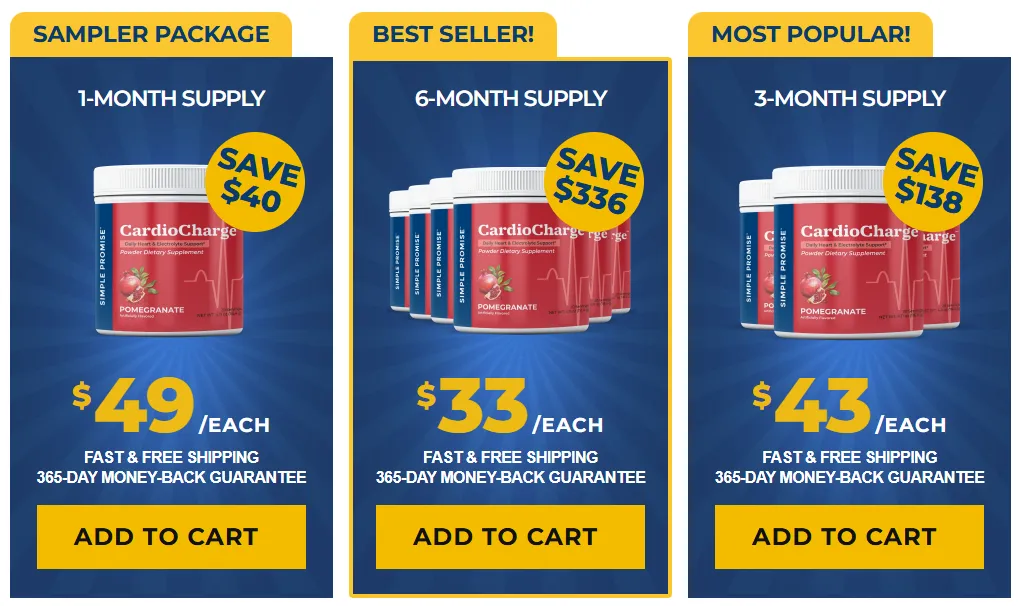
CardioCharge package options: 1-month supply $49 each (save $40), 6-month supply $33 each (save $336) and 3-month supply $43 each (save $138), each with fast and free shipping and a 365-day money-back guarantee
  • 1-Month Supply · 1 tub · $49 each · total $49 · save $40
  • 3-Month Supply · 3 tubs · $43 each · total $129 · save $138
  • 6-Month Supply · 6 tubs · $33 each · total $198 · save $336

Order CardioCharge Now

Credit card or PayPal at checkout · Fast & free shipping · 365-day money-back guarantee

CardioCharge Ingredients – Frequently Asked Questions

How many active ingredients are there?
Seven: D-Ribose, hibiscus flower extract, Hytolive® olive extract, potassium, magnesium, sodium and L-Glycine.
Which ingredient has the largest amount?
D-Ribose, at 3,000 mg per serving, followed by L-Glycine at 1,000 mg.
Which ingredients are electrolytes?
Potassium (380 mg), magnesium (190 mg) and sodium (140 mg).
Are there any stimulants?
No. The formula has no caffeine and no stimulant ingredients.

Keep exploring: General FAQs Ingredients article

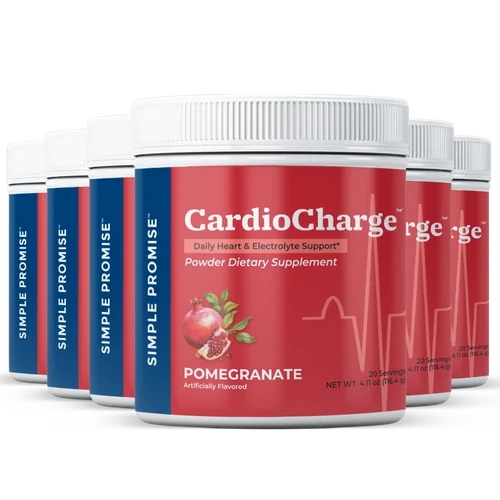
Six CardioCharge pomegranate powder tubs

Happy With the Formula? Order CardioCharge

Now that you know every ingredient and amount, the order page shows the current package prices, free shipping and the 365-day guarantee.

Order CardioCharge

Secured payment · 365-day money-back guarantee

Before you order: review the ingredients read the reviews check the FAQ see the refund policy

Order CardioCharge · Free Shipping